If you are somewhat interested in web development and the architecture behind a web page, you have most likely heard the terms frontend and backend . One could say that these two concepts stand for two sides of the same coin, where the coin is then the modern website or application. The architecture and the interaction between frontend and backend is crucial for how well a website works in many respects, such as user-friendliness , functionality and even SEO .
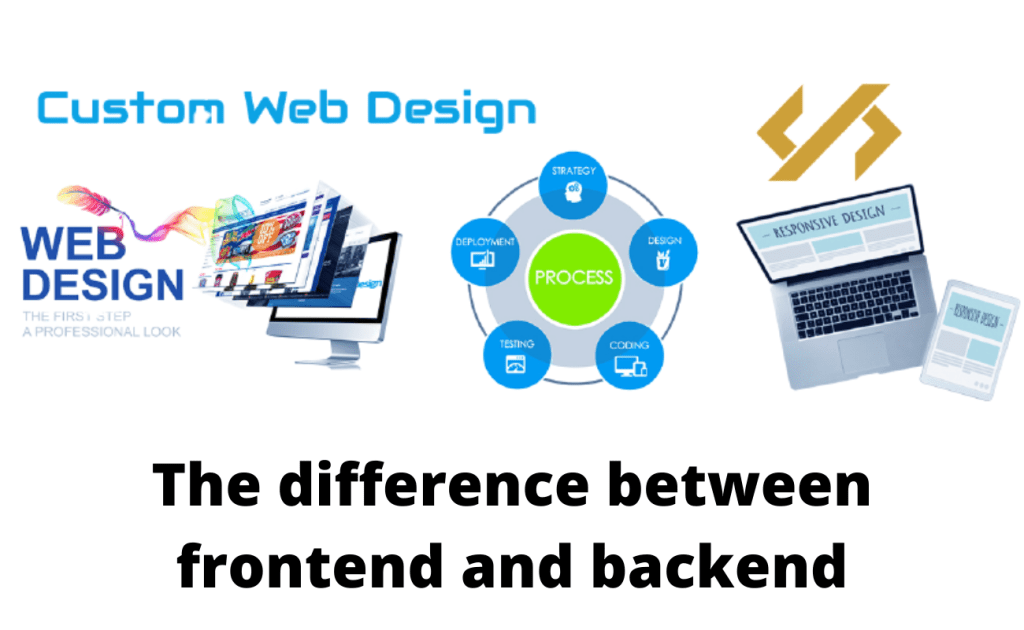
“The clearest distinction between frontend and backend is that frontend is what the user sees and interacts with in their browser, and backend is what never reaches the user’s computer but stays on the server”
The difference between frontend and backend can be described clearly, or more complex, depending on where you draw the line. Right now, a lot is happening in many different areas simultaneously in web development, and the traditional way of building websites can be history in just a few years. But so far we can quite easily define the clearest difference between frontend and backend, and that is that the frontend is what the user sees and interacts with in their browser and the backend is what never reaches the user’s computer but stays on the server .
Frontend – what is displayed in the browser
You can thus define the front end as what the person who opens a web page on their computer can see and interact with. Texts, images, buttons, forms, everything that the average internet user associates with a website, fits within the front end. The person who creates the front end of a web page is usually called a web designer and it is this person, or people, who have the task of ensuring that the page is stylish, functional and also that it works on many different platforms as different browsers for both computers, mobiles and tablets. Frontend is also called client-side in English , and the “client” in this case is your browser.
The three corner pillars in the front end
To create a modern frontend, three languages are used: HTML, CSS and Javascript. Here we take a closer look at these:
- HTMLHTML, hyper-text markup language , is the classic markup language for creating websites. All elements of a web page are marked in the HTML code. In this text, for example, each paragraph and heading has a so-called tag that describes how the content should be displayed. The same goes for pictures, menus and everything else you see on the page. The browser reads the HTML code when you upload the page, in order to know how the content should be displayed.
- CSSCSS stands for cascading style sheets , and was created to give web developers a more nuanced tool for how the content on a page should be presented. Without CSS, this website would look much like it did in the childhood of the Internet, that is, it would mostly consist of a lot of tightly packed text in a long flow. With the help of CSS, you can instead decide the color, size and shape of all elements on a website, and exactly where on the screen they should be displayed. CSS, for example, is crucial to being able to create web pages that can be displayed on many different platforms. The language can be integrated into the HTML code, but it is more common for the browser to receive one or more separate CSS files when the page is uploaded.
- JavascriptJavascript is the third pillar in modern web development. It is a so-called scripting language, that is, it is created to perform automated actions in a special driving environment, in this case the browser. With the help of Javascript, a website can be made dynamic, which means that it can be changed based on how the user interacts with it. Javascript is used, among other things, to create login functions, create the logic in contact forms and ensure that the information filled in is sent to the server, and so on. The contact between frontend and backend is managed using Javascript.
Backend – the brain of the web page
When a user enters an address in their browser, it does not lie and wait somewhere in the computer. It’s somewhere else. This place is called the backend, and it consists of one (can be several) servers, which the browser contacts and asks to have the page sent to it. Backend code is therefore often called server-side code. This is where most of the logic in a web application is found and the backend page can do pretty much anything at the request of the page’s frontend.
But to begin with, it sends HTML, CSS and Javascript to the browser so that the website can be displayed. It can then take care of validating user data, saving, retrieving or updating data to and from a database, sending out emails, making complicated calculations based on user data and so on.
Many languages to choose from on the server side
Anyone who wants to write code for backend has a number of languages to choose from, unlike Frontend where you have to stick to the three main languages. Some examples of common backend languages are Java, .NET, Python and PHP.
For a few years now, Javascript can also be used for backend programming, thanks to the Node.js runtime environment, which has allowed the once-limited scripting language to move out of the browser and develop into a more “real” object-oriented programming language. The fact that Javascript can also be used on the backend also makes it easier for a programmer to be able to write code for both the front and backend of an application, so-called full stack development.
Where does SEO get into all this?
SEO is in itself neither frontend nor backend, but is really a marketing technique. With that said, an SEO Experts should get as good an idea as possible of what the architecture for both frontend and backend means for a website.
When so-called onpage optimization is done, it is above all the front end of the page that is tailored, such as appearance and user-friendliness, meta tags and content. But even a page’s backend is of great importance for SEO with regard to, for example, canonization of links, upload speed, delivery of services and so on. SEO should basically be a collaboration between SEO technicians, web developers and backend developers to be as successful as possible.

